

Lighting is one of the most powerful yet often underestimated elements of interior design. Beyond enabling visibility, light directly influences human perception, emotional state, productivity, comfort, and even biological health. Modern lighting design has evolved from a purely functional discipline into a science-driven practice that integrates architecture, psychology, neuroscience, and human-centered design. At LIVMOR, we approach lighting design with exceptional care, recognizing its profound influence on how people experience, perceive, and interact with a space.
At the heart of contemporary lighting design lies the concept of layered lighting—the strategic combination of multiple types of light to create balanced, adaptable, and visually engaging environments. Whether in a home, retail store, hotel, office, or corporate workplace, layered lighting allows designers to shape atmosphere, support activities, and improve occupant well-being. The most successful spaces are not necessarily the brightest, but those that use light thoughtfully to shape perception, support activity, and enrich human experience.
Our design team at LIVMOR shares the principles of layered lighting design and explains how different lighting strategies can be used to create specific moods in residential, commercial, and workplace settings, based on established scientific research and lighting design best practices.
The Science of Light and Human Perception
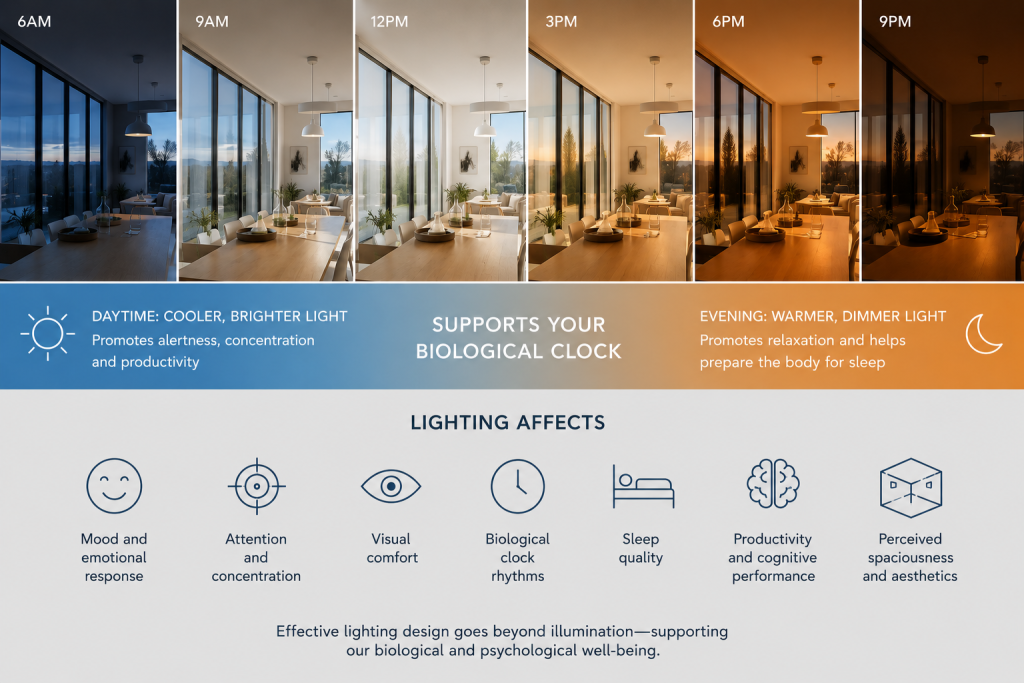
Human beings evolved under natural daylight cycles. As a result, our visual and biological systems remain highly sensitive to light intensity, direction, color, and timing.
Research in environmental psychology and chronobiology demonstrates that lighting affects:
- Mood and emotional response
- Attention and concentration
- Visual comfort
- biological clock rhythms
- Sleep quality
- Productivity and cognitive performance
- Perceived spaciousness and aesthetics
The human biological clock system is particularly responsive to blue-enriched light during daytime hours. Exposure to bright, cooler light helps maintain alertness, while warmer, lower-intensity light in the evening promotes relaxation and prepares the body for sleep.
Consequently, effective lighting design should not only illuminate spaces but also support human biological and psychological needs.
Understanding Layered Lighting
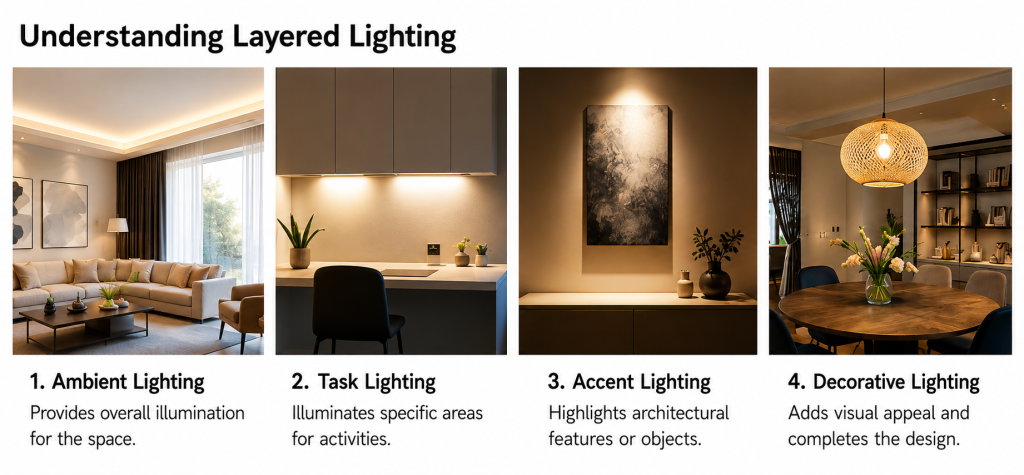
Layered lighting combines several categories of lighting, each serving a distinct purpose.
1. Ambient Lighting
Ambient lighting provides the overall distributed illumination of a space. It creates the overall brightness level and allows occupants to move safely and comfortably.
Common sources include:
- Ceiling-mounted fixtures
- Recessed downlights
- Pendant lighting
- Indirect cove lighting
- Large wall sconces
- Natural daylight pouring through windows or unique floor lamps.
Ambient lighting establishes the foundation upon which all other lighting layers are built.
2. Task Lighting
Task lighting is designed to support specific visual activities that require greater illumination.
Examples include:
- Reading lamps
- Under-cabinet kitchen lighting
- Desk lamps
- Vanity lighting in bathrooms
- Conference table lighting
Research shows that inadequate task lighting increases visual fatigue and can negatively impact productivity and accuracy.
3. Accent Lighting
Accent lighting creates visual interest by highlighting specific architectural features, artwork, displays, or textures.
Examples include:
- Track lighting
- Adjustable spotlights
- Display case lighting
- Wall grazing fixtures
Accent lighting introduces depth and hierarchy within a space, directing attention to focal points.
4. Decorative Lighting
Decorative lighting serves an aesthetic role and often functions as a visual centerpiece.
Examples include:
- Chandeliers
- Sculptural pendants
- Artistic wall fixtures
- Feature lighting installations
While decorative fixtures may contribute illumination, their primary purpose is visual expression and identity.
Key Lighting Characteristics That Influence Mood
Light Intensity (Illuminance)
Illuminance is measured in lux (lx).
Higher illumination levels generally increase alertness and energy, while lower levels tend to promote relaxation and intimacy.
Typical examples:
- Living room: 100–300 lux
- Restaurant dining area: 50–200 lux
- Office workspace: 300–500 lux
- Detailed task areas: 500–1000 lux
Color Temperature
Color temperature is measured in Kelvin (K).
Warm Light (2200–3000K)
Creates feelings of:
- Comfort
- Relaxation
- Intimacy
- Hospitality
Commonly used in:
- Homes
- Hotels
- Restaurants
- Lounges
Neutral Light (3500–4000K)
Creates:
- Balance
- Clarity
- Professionalism
Commonly used in:
- Retail spaces
- Healthcare facilities
- Commercial environments
Cool Light (5000–6500K)
Associated with:
- Alertness
- Focus
- Mental stimulation
Commonly used in:
- Offices
- Educational facilities
- Industrial settings
Direction of Light
The angle and direction of lighting dramatically affect perception.
Direct Lighting
Produces strong illumination and contrast.
Suitable for:
- Workstations
- Kitchens
- Retail displays
Indirect Lighting
Reflects light off walls or ceilings.
Benefits include:
- Reduced glare
- Greater visual comfort
- Softer atmosphere
Indirect lighting is frequently associated with luxury and wellness-oriented environments.
Contrast and Shadow
The human visual system naturally seeks contrast. Completely uniform lighting often appears flat and uninspiring.
Strategic variation in brightness creates:
- Visual hierarchy
- Spatial depth
- Architectural emphasis
- Emotional richness
Many high-end hospitality projects intentionally incorporate moderate shadow and contrast to create atmosphere and sophistication.
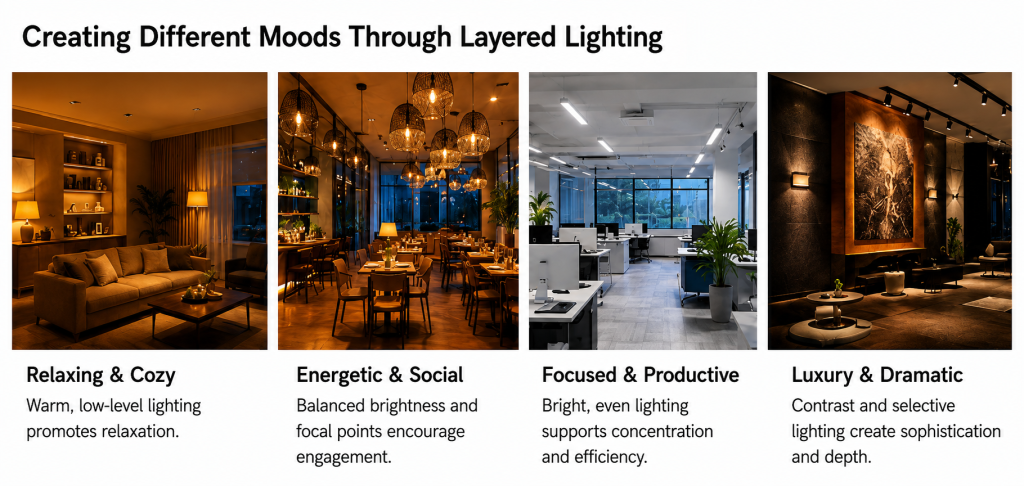
Creating Different Moods Through Layered Lighting
Relaxing and Cozy Mood
Characteristics:
- Warm color temperatures (2200–3000K)
- Lower illumination levels
- Indirect lighting
- Multiple light sources
Techniques:
- Table lamps
- Wall sconces
- Cove lighting
- Dimmable fixtures
Applications:
- Residential living rooms
- Bedrooms
- Hotel suites
- Lounge spaces
The combination of warm light and low contrast helps reduce physiological arousal and supports relaxation.
Energetic and Social Mood
Characteristics:
- Moderate to high brightness
- Layered focal points
- Balanced contrast
Techniques:
- Accent lighting
- Decorative pendants
- Adjustable scene settings
Applications:
- Dining rooms
- Restaurants
- Entertainment venues
- Retail environments
The goal is to encourage engagement, interaction, and visual stimulation.
Focused and Productive Mood
Characteristics:
- Higher illumination levels
- Neutral to cool white light
- Uniform task lighting
Techniques:
- Direct-indirect office fixtures
- Task lamps
- Glare-controlled luminaires
Applications:
- Offices
- Home workspaces
- Meeting rooms
- Educational facilities
Studies consistently show that adequate vertical and horizontal illumination improves concentration and reduces visual strain.
Luxury and Dramatic Mood
Characteristics:
- Controlled contrast
- Selective illumination
- Strong focal points
Techniques:
- Wall washing
- Grazing textured surfaces
- Spotlighting architectural features
Applications:
- Hotels
- High-end retail
- Executive offices
- Residential feature areas
Luxury environments often use less overall light than expected, relying instead on carefully orchestrated layers and contrast.
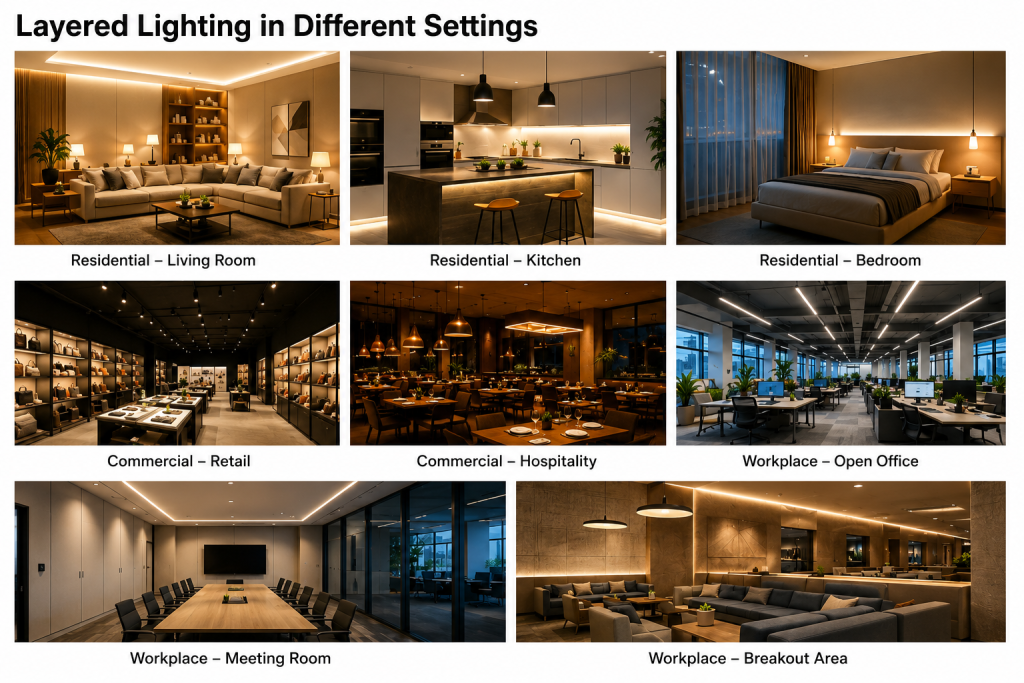
Layered Lighting in Residential Settings
Residential lighting should support multiple activities throughout the day while promoting comfort and well-being.
Living Rooms
Recommended layers:
- Ambient ceiling lighting
- Accent lighting for artwork
- Table and floor lamps
- Decorative feature fixtures
Dimming capability allows occupants to transition between social gatherings, entertainment, and relaxation.
Kitchens
Recommended layers:
- General ceiling illumination
- Under-cabinet task lighting
- Island pendant lighting
- Accent lighting for architectural features
Proper task lighting significantly improves visibility and safety during food preparation.
Bedrooms
Recommended layers:
- Soft ambient lighting
- Bedside reading lights
- Indirect cove lighting
- Decorative lighting elements
Warm lighting in the evening helps support healthy biological clock rhythms and sleep preparation.
Layered Lighting in Commercial Environments
Commercial spaces use lighting not only for visibility but also for brand communication and customer behavior.
Retail Spaces
Research indicates that lighting can influence:
- Product perception
- Customer dwell time
- Purchase decisions
Recommended layers:
- Ambient store lighting
- Accent lighting on merchandise
- Feature lighting at displays
- Decorative brand-focused elements
Higher contrast often directs customer attention toward premium products.
Hospitality Environments
Hotels and restaurants frequently rely on sophisticated layered lighting to create memorable experiences.
Recommended layers:
- Soft ambient lighting
- Accent lighting on architectural details
- Decorative feature fixtures
- Adjustable scene controls
Dynamic lighting allows operators to adapt atmospheres throughout the day.
Layered Lighting in Workplace Settings
Modern workplace lighting has shifted from simple illumination toward supporting wellness, collaboration, and productivity.
Open Offices
Recommended layers:
- Uniform ambient lighting
- Task lighting at workstations
- Accent lighting in collaboration zones
- Decorative lighting in social spaces
Modern office design increasingly emphasizes vertical illumination to improve facial recognition and communication.
Meeting Rooms
Recommended layers:
- Adjustable ambient lighting
- Presentation lighting
- Video conferencing lighting
- Accent lighting
Different activities require different lighting scenes, making controls essential.
Breakout and Wellness Areas
Recommended layers:
- Warm ambient lighting
- Decorative fixtures
- Indirect lighting
- Feature lighting
These spaces benefit from a more residential atmosphere that encourages recovery and informal interaction.
The Importance of Lighting Controls
Even the most carefully designed layered lighting system cannot achieve its full potential without effective controls.
Key technologies include:
- Dimmers
- Occupancy sensors
- Daylight harvesting systems
- Tunable white lighting
- Smart lighting controls
Lighting controls allow users to modify intensity and color temperature according to activity, time of day, and personal preference.
Research consistently shows that providing occupants with control over their lighting environment improves satisfaction and perceived comfort.
Layered lighting design is both an art and a science. By combining ambient, task, accent, and decorative lighting, designers can create environments that are functional, aesthetically compelling, and supportive of human well-being.
Scientific research demonstrates that light influences mood, productivity, comfort, and biological rhythms. Consequently, effective lighting design should move beyond simple illumination and embrace a holistic approach that responds to human needs and spatial objectives.
Whether designing a residential living room, a retail environment, or a modern workplace, layered lighting provides the flexibility to create diverse moods and experiences while enhancing the quality of the built environment.